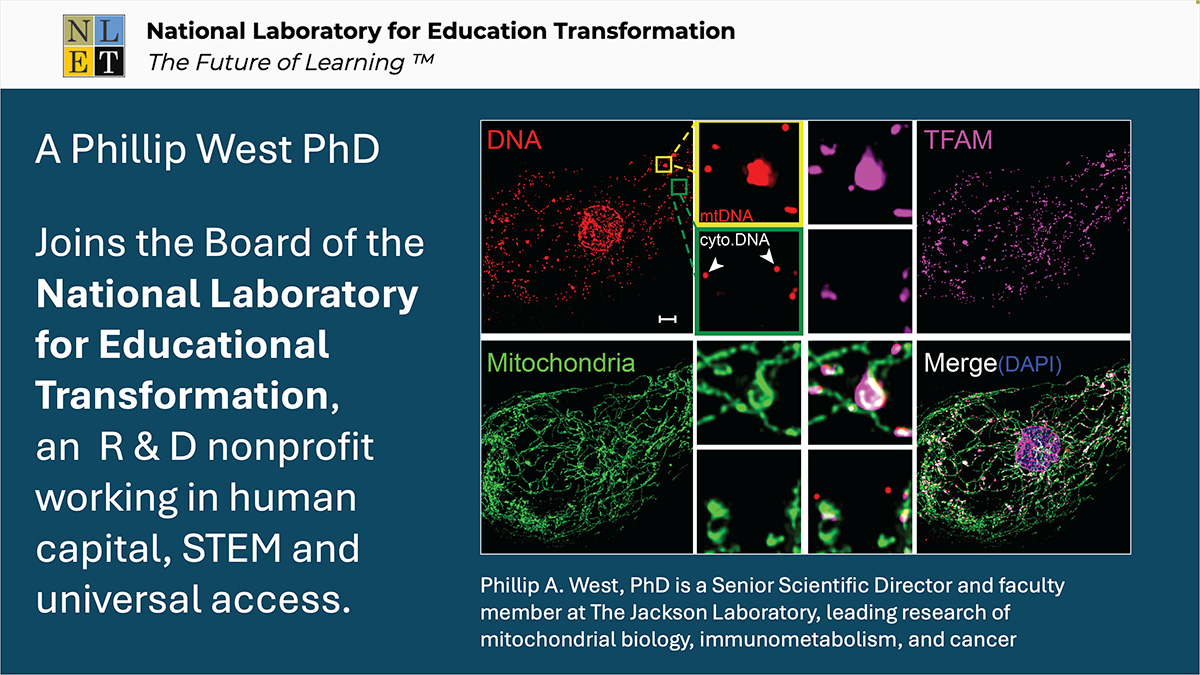
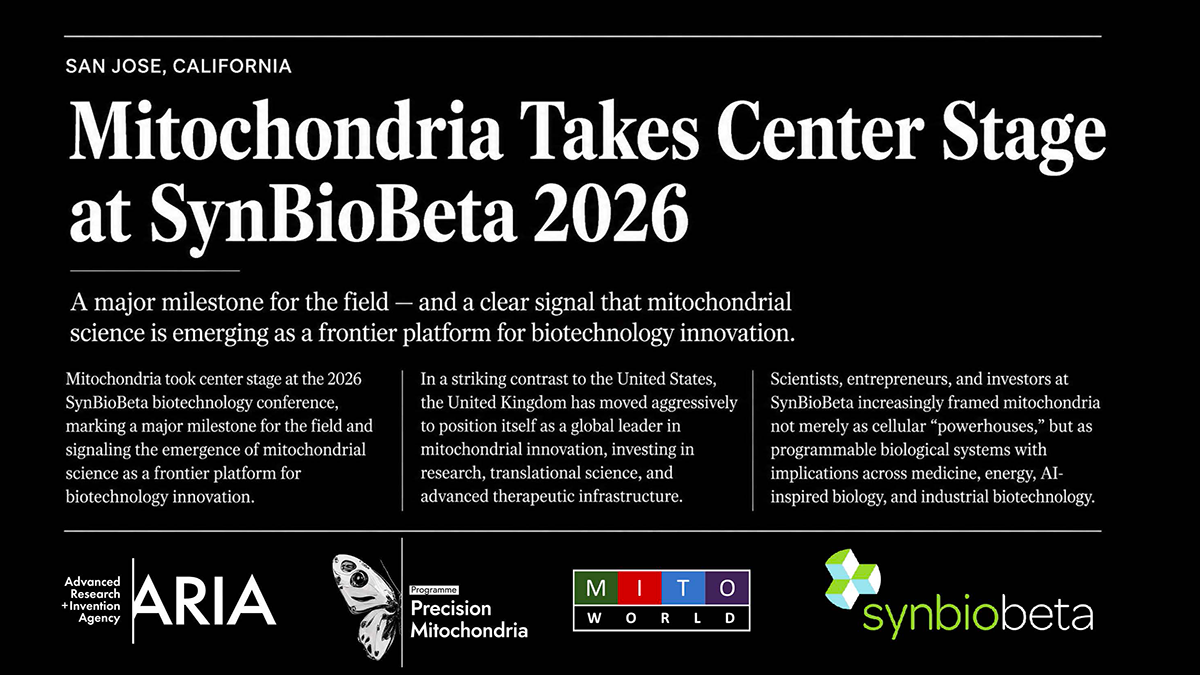
A Report from the Mitochondria Panel at SynBioBeta conference in San Jose, CA, May 7, 2026
For the first time in the conference’s fourteen-year history — SynBioBeta draws up to 1,500 founders, investors, Fortune 500 executives, scientists, and government program managers annually — mitochondrial had its own dedicated session in the Longevity Track. The session was titled “Mitochondrial Transplantation and Genome Editing: Engineering the Metabolic Engine of Complex Life.” It filled the room and ran long.
Why Mitochondria, and Why Now?
Before the panel opened, it’s worth establishing what the conversation was actually about — because most people in the room had been told since high school that mitochondria are the powerhouse of the cell, and stopped there.
Mitochondria sit at the intersection of aging, metabolic disease, neurodegeneration, cancer, and cellular resilience. The science has been building slowly for decades, largely outside the mainstream of medicine, research and health. For those who understand the intricacy of the mitochondria, its mtDNA, its interactions with the nucleus and its evolutionary symbiosis that formed life as we know, a question has loomed – can we manipulate mitochondria for improvements in therapy, quality of life and longevity?
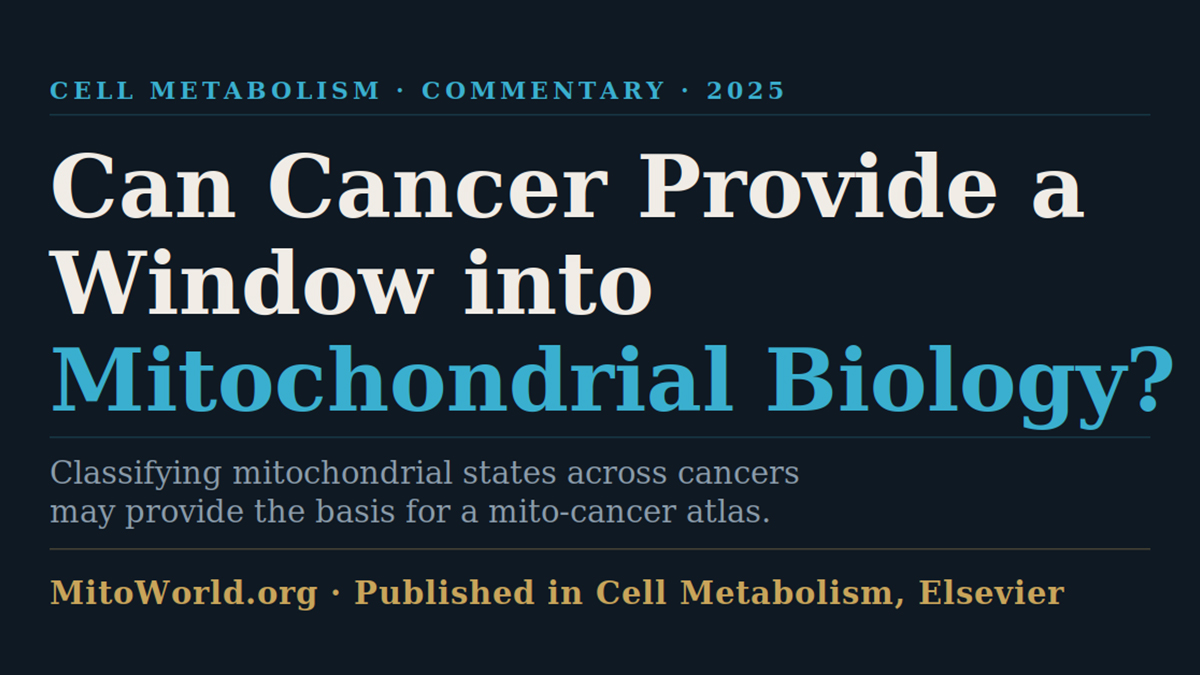
Across the landscape of cancer and tumors, the complex involvement of mitochondria are coming into focus: mitochondria in cancer ecology run a range of dynamics, re-programmability, with high overall plasticity. Their form, function, and behavior have been seen in cancers and tumors to be dramatically differentiated by tissue, organ, and cancer. An added layer is that mitochondria have their own DNA, mtDNA, separate from the cell’s nuclear DNA. This raises the question: Can mitochondria be transferred between cells, and resume function? Can they be edited. Or engineered? And nature itself already performs an extraordinary range of mitochondrial configurations across the physiology — which is precisely what makes them such compelling engineering targets – or “platforms.”
A Government Steps In
Mitochondria are difficult to manipulate with drugs and equally challenging to edit their tiny genomes dedicated to making ATP and powering a range of signaling and clean-up or cell death roles. This has made the funding landscape difficult, but also promising. In the U.S., surprisingly little attention is paid to this deep partner in life, disease and death. However, the opposite is true in the U.K, a committed outlier, that has recognized in national health policy, and now innovation funding that mitochondria could lead to a revolution akin to nuclear genomics fifty years ago.
Ryan Olf, a Californian by birth, holds one of the most unusual jobs in science right now: Programme Director of ARIA’s Precision Mitochondria Programme. ARIA is the UK’s DARPA-inspired breakthrough research agency — built explicitly to fund the kind of high-risk, high-reward science that conventional grant-making cannot reach. The fact that an agency like ARIA has placed a major bet on mitochondrial engineering is itself data.
Panelists
Ryan Olf — “My main job is maximizing ARIA’s chances of success and their potential translational impact, in the UK and beyond. We’re just about to kick off the research — teams chosen, contracts being finalized — and there isn’t much I currently needed from the SynBioBeta community to hit our programme’s immediate technical goals. But panels like this one can really move the needle on the long-term impact of our work.”
The mechanism he described is compounding: more people appreciating the role of mitochondria means more people working with them, which means more people possibly using and further developing the tools ARIA is building, which increases the odds those tools get used for what Ryan calls “history-defining breakthroughs — cures for neurodegenerative disease or some cancers among them.”
For a synthetic biology audience, he framed it even more directly:
“Mitochondria are potentially model organisms sitting at the heart of life’s complexity. With the tools we’re developing, they could be the perfect chassis for bridging the most powerful instruments of synthetic biology — sensor-actuator circuits and robust programmability — into eukaryotic cells.”
ARIA’s funding choices will be disclosed within two months.
Crossing a Threshold
Maximilian Sichrovsky — Science & Technology Lead for ARIA’s Precision Mitochondria programme, and a biochemist whose own Cambridge PhD focused on mitochondrial membrane transport — was watching the room as much as the stage. What he saw was engagement.
“The scientific case for ignoring difficult problems in mitochondrial biology is becoming increasingly hard to ignore. I think the field is slowly crossing a threshold where the tools to intervene are actually catching up with rising ambitions. What struck me most about the session was how engaged people were — also afterwards, asking me questions and making connections to their own work.”
He was candid about what ARIA’s model is trying to do that the existing ecosystem cannot:
“Most of the mitochondria work being done right now is either deep in academia or scattered across early-stage biotechs. What the ARIA programme is trying to do — coordinate across those silos, set ambitious technical targets, and de-risk the space at a programme level — is a model that doesn’t have many precedents in biotech.
What he found inspiring wasn’t just the established scientists in the room. “Having younger students in the crowd excited about bioenergetics is really inspiring,” he said.
From the Clinic and the Clinic-to-Be
Dr. Colwyn “Coco” Headley works at Stanford’s Cardiovascular Institute, where his mitochondrial transplantation research has drawn support from two institutions that don’t usually fund the same science: NASA NIAC and the American Heart Association. His work sits at what he calls the gap — the distance between bold concepts and the rigorous preclinical validation needed before anything reaches a patient.
“The growing interest from across synthetic biology, cell therapy, aging, and translational medicine signals that the field is moving quickly from an emerging concept into a serious platform for therapeutic innovation. More sustained investment will be needed to bridge the gap between bold concepts, rigorous preclinical validation, and eventual clinical translation.”
He was equally clear about the public education challenge:
“It will be important to re-educate and update the public on the far-reaching impact of mitochondrial health — not only within individual cells, but collectively across tissues, organs, and whole-body systems. The systemic story is what will ultimately drive the clinical and investment momentum this field needs.”
Building on “the Platform”
Mariëlle van Kooten came to the session from inside the startup that is trying to do the engineering work in real time. She co-founded Powerhouse Biology out of a Stanford postdoc and a PhD in Synthetic Systems Biology at ETH Zurich — where her doctoral work contributed to international efforts to build a synthetic cell. Her company is developing precision protein and peptide therapeutics targeting mitochondrial dysfunction, with a mission she describes plainly: reboot the human powerplant. Advisors include Ron Davis of the Stanford Genome Technology Center, Seth Shipman at the Gladstone Institutes, and Pat Sharp, co-founder at Gate Bioscience.
On what makes mitochondria a genuine engineering platform — not just a research subject:
“Mitochondria carry their own heritable genome, are safely enclosed by a double membrane, share conserved biology with well-studied prokaryotes, and as a defined subsystem within the cell they’re feasibly computable. It’s a combination unique among organelles.”
On what has changed to make the moment viable:
“Mitochondria were always a compelling engineering target. What’s changed is that the computational tools now match the dimensionality their biology demands — and the biological tools can validate real candidates. Repair is where Powerhouse starts; the unmet need is immediate and the validation is clearest. But the platform is built to push toward enhanced resilience and durability over the longer arc.”
The Room After the Session
After the formal panel ended, people stayed. That’s usually an indicator that something landed.
Justin Cooper is a tenth grader at Lick-Wilmerding High School in San Francisco, at SynBioBeta because he’s interested in bio entrepreneurship. He called the mitochondria session his favorite workshop of the conference.
“I learned the fundamental differences between mitochondria and nuclear DNA — mitochondrial DNA being passed from the mother — as well as the nuances and severe difficulty of attempting to edit it. I see great potential in the bioengineering of mitochondria in cancer research and human performance. Building a virtual mitochondrial model would be a key step in the creation of full virtual cell models. Techniques such as using phage-derived enzymes could hold promise in precisely editing mitochondrial DNA.”
His next step: researching how engineering mitochondrial DNA might be used to prevent cancer — specifically targeting cancer mitochondria to prevent their function. A tenth grader, leaving with a research agenda.
Devashree Hemant Agarwal, an undergraduate research assistant in the Bioinformatics Lab at San Jose State University, was also there — and her reflections on what drew her to the session.
“I was just curious about seeing the newest research and progression on mitochondria. The panel discussion was very informative, and had professionals from the industry, academia, and start-ups; so, we got to listen to different perspectives on a very concentrated area of research. It was my first time listening to a panel focused on mitochondrial and gene editing research, and I got to learn a lot of new things!
Dr. Laura Hix Glickman, Co-Founder and CEO of Adjuvia Therapeutics, was also in the room. A cancer immunologist and serial biotech entrepreneur with over 25 years of experience, she co-invented one of the first synthetic astaxanthin derivatives and has spent years studying the role of mitochondria in oxidative stress, inflammation, and cancer. Adjuvia is developing ATI-105 — an oral small molecule nanoparticle formulation targeting mitochondrial dysfunction — for Friedreich’s Ataxia and Leigh Syndrome, with planned clinical trials at CHOP initiating later this year.
On what drew her to the session:
“I was thrilled that there even was a panel focused on mitochondria — it’s about time. I truly believe this is the beginning of a new era, and to learn about the new ways and new tools scientists are using to better understand mitochondrial biology was very exciting.”
On the U.S. government’s relative silence on mito-tech:
“These are difficult days for US research, and we are ceding ground to the rest of the world across all of our research and development agencies due to the unprecedented pullback in government funding. But we will learn what we can from our friends overseas while we wait out this administration, and I know now we have many dedicated scientists who are undaunted in their quest to unlock the secrets of mitochondrial biology.”
What This Moment Means
The SynBioBeta session was not a single event. It was a signal.
For the first time, the Bay Area’s defining synthetic biology conference made room for mitochondrial bioengineering as a serious platform technology — not a curiosity, not a footnote, but a session in the Longevity Track alongside gene editing, synthetic proteins, and AI-driven drug discovery. In the room: a UK government program director running a DARPA-equivalent mitochondria initiative. A startup founder building the first mitochondria-targeted therapeutics for childhood rare diseases. A Stanford researcher funded by NASA and the American Heart Association. A tenth grader leaving with a cancer research agenda. An undergraduate bioinformatics researcher whose questions reflected exactly the next generation the field needs.
Mitochondrial bioengineering is not a future possibility. It is happening now — in California labs, in UK government programs, in a new generation of startups whose founders see in mitochondria what an earlier generation saw in mRNA: a platform capable of addressing an enormous range of human disease and aging.
The conversation is open. The conversation is open. We, at www.MitoWorld.org, hope to start a Mito-Bioengineering working group, meet-ups and webinars.
Contact: Info@MitoWorld.org | www.MitoWorld.org