
- Download the report
- Comments: info@NLET.org
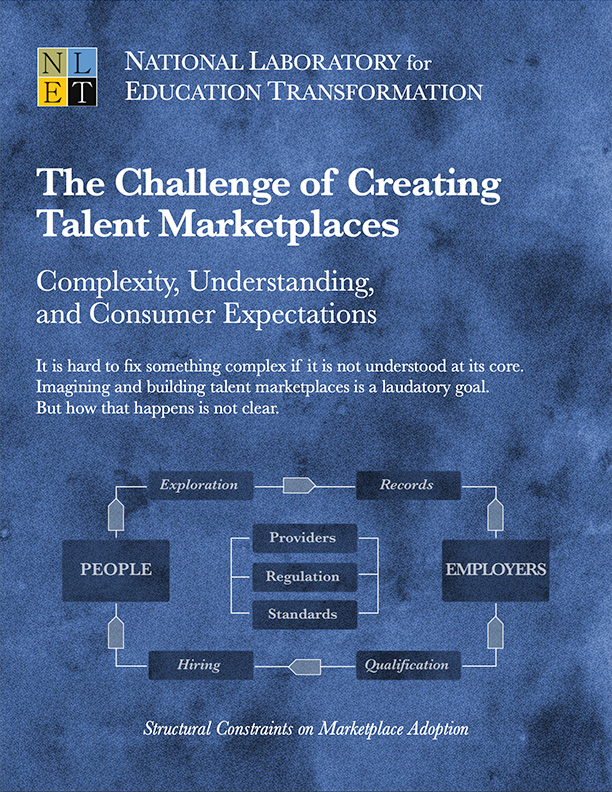
The Challenge of Creating Talent Marketplaces: Complexity, Understanding, and Consumer Expectations
The Talent Marketplaces white paper examines the persistent gap between widespread policy interest in talent marketplaces and the limited success of existing efforts to build and scale them. Against the backdrop of rapidly shifting labor markets, skills-based hiring models, and accelerated digital transformation, the report argues that traditional education and workforce systems are structurally unable to function as true marketplaces because they were not designed with scale, consumer engagement, or real-time market signals in mind.
The paper begins by observing that human capital systems remain fragmented. Education, workforce development, and employment services operate as separate establishments with different funding mechanisms, governance structures, and data architectures. Individuals navigating this landscape often encounter disconnected systems and disjointed information, while employers lack integrated means to signal demand. This fragmentation is further exacerbated by siloed technologies that support compliance, reporting, and credential storage, but provide limited ability to attract and retain participating individuals or employers at scale.
A central observation of the report is that many current talent marketplace initiatives stumble not because the marketplace concept is fundamentally flawed, but because marketplace designs are anchored in the wrong technology and data assumptions. Platforms built atop legacy administrative systems or compliance-centric databases were never engineered to serve millions of users, enable consumer choice, or generate robust demand signals. For talent marketplaces to function effectively, they must engage people directly—making it easy for individuals to explore opportunities, understand pathways, and act on real-time labor market signals in a way that feels analogous to consumer platforms in other sectors.
From the NLET perspective, scale is not a secondary concern—it is a prerequisite for a functioning marketplace. Without a large and active population of users, marketplaces cannot produce trustworthy signals about skills, mobility, or demand, and they fail to attract the sustained participation necessary to generate value for all stakeholders. The paper highlights how many existing designs implicitly assume participation will flow from administrative referrals or program mandates rather than from voluntary, consumer-driven engagement.
On the employer side, many marketplace efforts rely on narrow engagement models—such as advisory boards or pilot partnerships—that struggle to attract a broad base of employers. Without seamless integration into hiring workflows, marketplaces fail to reflect real labor demand, weakening the incentives for individuals to participate.
The report stresses that these limitations are not primarily policy failures but design failures: marketplaces are too often envisioned as extensions of existing systems rather than as consumer-first environments capable of competing for attention and usage in a crowded digital ecosystem. Drawing parallels to successful marketplaces in travel, commerce, and information services, the paper suggests that future talent marketplace development must involve technology and engagement strategies capable of large-scale adoption, including leveraging web-scale players and hybrid models that balance public mission with consumer usability.
Ultimately, the white paper makes the case that addressing technology choice, consumer adoption, and market formation—not merely improving data standards or funding pilots—is essential to realizing the promise of talent marketplaces as a scalable, equitable ecosystem connecting learning and work.